
|

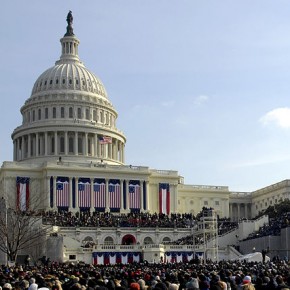
The American presidential inauguration occurs every
four years and invites a spectacular amount
of fanfare. The new president gets his own day of feasting,
procession, statesmanship, and
celebration. The United States marks its transition of government
with a day
of events that
have developed over time to become
our modern-day inauguration. The
theme
for the 2005 inauguration of George W. Bush honors the bicentennial of the
Lewis and Clark expedition to the Pacific, along with the centennial of
the inauguration of another great explorer, Teddy Roosevelt.

The first president,
George Washington, was inaugurated at Federal Hall in New York on April
30, 1789. Washington repeated the oath, read by Chancellor Robert
Livingston of New York, with one hand on the Bible: “I do solemnly swear
that I will faithfully execute the office of the President of the
United States and will, to the best of my
ability,
preserve,
protect, and defend the Constitution of the United States.”
Establishing a custom that has been followed by all succeeding presidents,
Washington added, “So help me God” at the end. In eloquent Enlightenment form, Washington’s
inaugural address
spoke of “the Great Author of every public and private
good,” “the Invisible Hand which conducts the
affairs of men”, and civic virtue required for successful government.
Washington needed only
135 words to complete the address at his
second inauguration in 1793.
Some 48 years later, President William Henry Harrison needed 8495 words to
complete
his
address.
During that address, which lasted some two hours in the cold weather,
Harrison failed to wear a winter coat and developed pneumonia. He died a
month later.
The tradition of
presidential procession of both the president-elect and
soon-to-be-ex-president has its
roots in the 1837 inauguration. On inauguration day that year, Andrew Jackson and Martin Van Buren met and
traveled to the Capitol together in a wooden carriage built from the
remains of the U.S.S. Constitution. This processional tradition
has been followed by all presidents with the exception of
outgoing-president Andrew Johnson, who in 1869 remained in the Capitol
signing legislation until the noon expiration of his term.
Thought to be the
greatest of all addresses, Abraham Lincoln gave his
second inaugural address in March,
1865.
With the Union embroiled in civil war, Lincoln invoked God to bring a
speedy end to the fighting. However, he went on state his acceptance
if God were to allow bloodshed to continue after hundreds of years of
slavery, because “the judgments of the Lord are true and righteous altogether.”
Under the Twentieth
Amendment, the date of the Presidential Inauguration was moved from March
to January 20, which falls a couple of weeks after the certification of
votes of the Electoral College. The last president to be inaugurated
in March after an election year was Franklin D. Roosevelt in
1933.
After re-election in 1936, Roosevelt was the first president to be
inaugurated under the new amendment on January 20,
1937.
Roosevelt’s 1933
inauguration is also noteworthy because of what he did before his
swearing-in. FDR went with his wife to St. John’s Episcopal Church
for a church service on the morning of March 4, setting a presidential
precedent of attending an inaugural-day worship event.
In 1961, John F. Kennedy
became the United States’ youngest and first Catholic president.
During his
inaugural address on January 20, he delivered his now-famous words,
“Ask not what your country can do for you, ask what you can do for your
country.”
Ronald Reagan broke with
tradition in 1981 by having his
presidential inauguration at the U.S. Capitol’s west front, which
could hold more visitors than the normally used east front.
Today, the presidential
inauguration carries on the traditions of inaugurations past, and perhaps
a new tradition will be created by something that occurs during
inauguration 2005. To learn much more about presidential inauguration
history,
please visit the inauguration website of the
Joint
Congressional Committee on Inaugural Ceremonies.
See sources
For more web resources on
the history of presidential inaugurations, please click on the sources
link above, or
click here for links to other web
sites. |
|